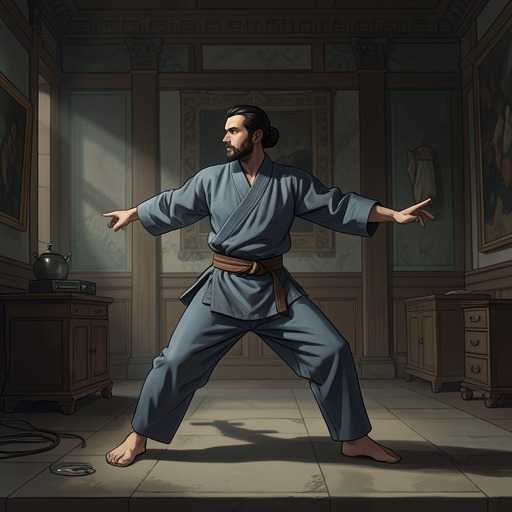
Attitude-No-Attitude
The Book of Five RingsAttitude-No-Attitude is the principle that a swordsman should not become fixed in any one Long sword stance. It does not erase the five attitudes; it treats them as adaptable ways of holding the sword, selected and changed according to the situation, the place, and the relation between opponents. Its governing continuity is not a posture but an intention: every movement, including a parry or contact with the enemy’s blade, must remain directed toward cutting. The expression joins bodily adaptability to strategic initiative and rejects defense as a settled state of mind.
Meaning and apparent paradox
The teaching begins with a provocation: there is no need for what are commonly called Long sword attitudes. Read literally, that might seem to deny the forms used to hold a sword. The explanation immediately qualifies it. The five ways of holding the Long sword still exist; what the teaching denies is that any one of them must be treated as a fixed or independently authoritative position.
The distinction is between forms and fixation. A stance is useful insofar as it makes a cut possible in the circumstances at hand, but the swordsman must be able to leave it when the situation changes. The principle is named “Existing Attitude - Nonexisting Attitude”: attitudes exist as usable forms, yet cease to exist as rigid commitments. The apparent contradiction is functional. The forms provide choices; freedom from attachment allows those choices to serve the encounter rather than dictate it.
Changing the sword’s position
The teaching describes how one attitude can give way to another. From the Upper attitude, as the spirit lessens, the swordsman can adopt the Middle attitude; from the Middle, the sword can be raised slightly to take the Upper attitude. From the lower attitude, it can be lifted into the Middle when the occasion calls for it. Turning the sword inward from either the Left Side or Right Side attitude can likewise produce the Middle or Lower attitude.
These shifts are not presented as a prescribed sequence or a new catalogue of fixed poses. Their measure is whether the sword can cut well in the particular situation, at the particular place, and in relation to the particular enemy. The ability to move among the attitudes is therefore practical rather than ornamental: a stance is neither a badge of style nor an end in itself, but a temporary arrangement of the weapon that can be changed as circumstances demand.
One intention through changing movements
Flexibility of stance does not mean uncertainty of purpose. The primary requirement when taking up the sword is the intention to cut the enemy, whatever means are used. Parrying, hitting, springing, striking, or touching the enemy’s cutting sword must be carried through as part of a movement that cuts. If the swordsman thinks only of making contact, striking, or deflecting, the movement may stop short of its purpose.
This constant intention gives the changing attitudes their coherence. The outer position may alter, but the action should not dissolve into separate defensive and offensive tasks. Attitude-No-Attitude is thus not passivity or improvisation without direction; it is adjustment governed by a clear end. The difference matters most when the enemy’s blade must be met: contact is not enough, and a successful response cannot be measured only by whether the incoming cut has been touched or turned aside.
Initiative, attention, and the trained body
The expression also belongs to a broader contrast between waiting to defend and taking the lead. The teaching rejects the defensive spirit called “attitude,” while the account of dueling advises attacking first and disturbing the opponent’s composure. The enemy can be confused or unsettled by attacks directed at a lapse in spirit; the swordsman who remains committed to a fixed defensive arrangement risks letting the opponent set the terms of the exchange. In this context, having no fixed attitude supports initiative rather than retreat.
That initiative depends on trained bodily control, not on a rigid pose. The general combat stance calls for an erect head, composed features, lowered shoulders, strength through the legs, and a braced abdomen; the Companion sword is wedged against the abdomen so the belt does not slacken. The gaze should be broad enough to take in distant things as if close and near things from a distance, while distinguishing the enemy’s sword from insignificant movements. The grip, too, must avoid dead fixedness: the last two fingers hold firmly, but the hand remains pliable rather than locked. Footwork moves left and right rather than favoring one foot. Together, these instructions describe readiness as an organized capacity to perceive and move—not as immobility.
The same principle extends from posture into close combat. In the method called Glue and Lacquer Emulsion Body, the fighter approaches and stays close with head, body, and legs, leaving no gap between the two bodies. In the Body Strike, the fighter enters through an opening in the guard, turns the face slightly aside, and drives the left shoulder into the enemy’s breast in time with the breath. These methods give the teaching a physical edge: responsiveness may mean changing the sword’s position, but it may also mean closing distance and committing the whole body when an opening appears.
A principle for strategy
Attitude-No-Attitude is stated as sword instruction, but it is consistent with the book’s effort to connect individual combat with larger strategy. The Way is organized into five books—Ground, Water, Fire, Wind, and Void—and the Ground book presents the foundations of the author’s school. The account insists that strategy cannot be understood through sword-fencing alone: the practitioner must learn to discern both the smallest and largest matters. At the scale of an army, strategic judgment likewise depends on reading the enemy’s condition, choosing an advantageous position, and moving forces in response.
The principle therefore offers neither a universal pose nor a rejection of technique. It asks the practitioner to distinguish what must remain constant from what must change: the intention to defeat the opponent persists, while the form of the response varies with the encounter. The book presents mastery as more than dexterity with a selection of movements. Training must develop the ability to see the situation, choose a workable action, and carry that action through. In that sense, “no attitude” names a discipline of adaptable form, not an absence of form.
The teaching also shapes how the Way is transmitted. The author says he dislikes passing it on through written pledges and regulations; he assesses pupils’ abilities, removes the bad influence of other schools, and gradually introduces them to the true Way of the warrior. He gives an outline of other schools’ tendencies without naming them or their main points, noting that different branches interpret doctrines differently and that no single person’s conception can stand for an entire school. Against formal divisions such as “gate” and “interior,” the Ichi school’s Long sword has neither gate nor interior, and its attitudes contain no inner meaning. The final requirement is to keep the spirit true and realize the virtue of strategy: forms can be taught and used, but no form should be mistaken for the Way itself.